

Resources and Services
Here are a few resources and services NEOCH offers or recommends to those in need. For a more detailed list, also look at our Street Card
Jump Down
NEOCH Housing Clinics
NEOCH offers weekly housing clinics. The clinics offer walk-in services for unhoused folks who are unsheltered and in need of street outreach support such as: linkage to services or assistance with housing options. Eligible housing applicants can begin filling out applications on the same day, and may also get assistance (including vouchers) in obtaining primary documents like ID's, drivers licenses, birth certificates, and social security cards. Housing clinics should not take the place of Coordinated Intake, NEOCH recommends reaching out to coordinated intake first at 216-674-6700 to register and become eligible for housing assistance.
*For the Cosgrove Center location on Tuesdays, it is advised to arrive early due to high volume.
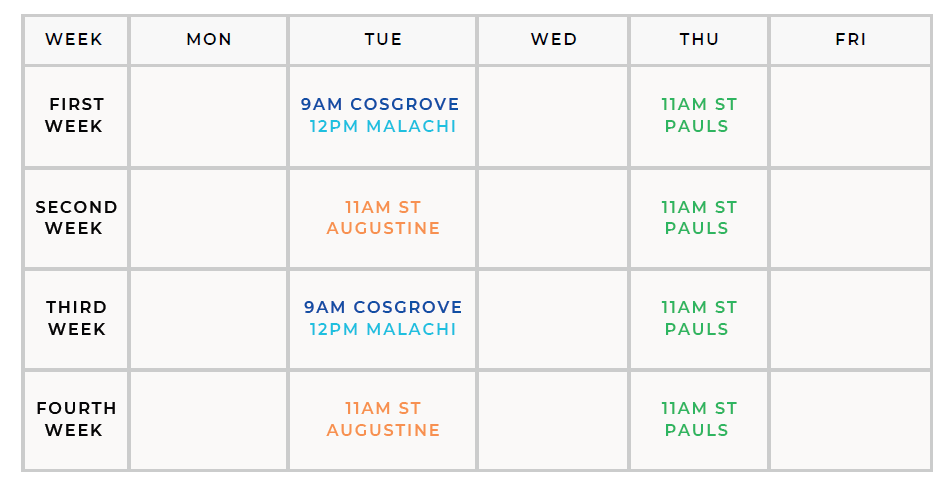
First & Third Tuesdays 9AM
Bishop William M. Cosgrove Center
1736 Superior Ave
First & Third Tuesdays 12PM
Malachi Center
2416 Superior Viaduct
Second & Fourth Tuesdays 11AM
St. Augustine Roman Catholic Church
2346 W 14th St
Every Thursday 11AM
St. Paul’s Community Church UCC
4427 Franklin BLVD. (Near St. Herman’s)
Homeless Congress
Homeless Congress is an organizing group of community members, advocates, and local leaders with lived experience of homelessness. Supported by NEOCH, the Congress meets monthly on the east and west sides of Cleveland, where sheltered, unsheltered, and formerly homeless residents are invited to discuss areas of mutual concern and pursue change.

-
To build power within Cleveland’s homeless community through solidarity and collective action
-
Unity * Solidarity Accountability * Integrity * Respecting People * Solution-Focused
-
The work of the Homeless Congress is based on the understanding that genuine progress in addressing homelessness can only be made if it is led by those most directly impacted - that is, people with lived experience of homelessness. It is this unique perspective that provides a broad view of the myriad social conditions that perpetuate homelessness, and what can be done to eliminate them. Collective action and leadership development are critical to building a unified voice among unhoused folks that can affect substantial change.
-
Amplifying homeless voices and protecting the rights of the unhoused
Prioritizing affordable housing
Eliminating barriers
Empowering tenants
-
People experiencing homelessness consistently face barriers that deprive them of their ability to acquire their most basic needs. The Homeless Congress expressly rejects this practice: community is a basic human necessity, and everyone deserves the opportunity to participate in it. All people with lived experience are welcome to join the Homeless Congress and contribute to the fight to end homelessness.
-
Homeless voices have been historically and systematically marginalized and silenced. If you want to be an advocate, the first and most important thing you can do is to speak out. Come to a Homeless Congress Community meeting and make your voice heard.
When: The second Tuesday (12:00 pm) and Thursday (1:00 pm) of every month
Where: Tuesday meeting (St. Paul’s Community Church) & Thursday meeting (Bishop Cosgrove Center)
Who: Anyone currently experiencing sheltered or unsheltered homelessness or people with lived experience of homelessness. The Homeless Congress especially needs people who can commit and attend meetings long-term.
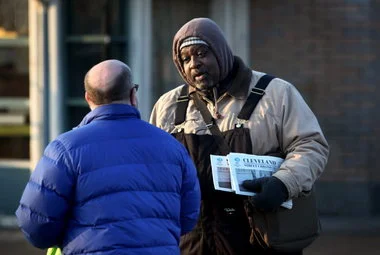
The Cleveland Street Chronicle
The Cleveland Street Chronicle is a quarterly newspaper that is almost entirely written, distributed, and promoted by individuals with lived experience of homelessness.
The Cleveland Street Chronicle contains articles addressing issues of homelessness and poverty in the community and has continued to provide a much-needed voice for Cleveland's unhoused community since 1991.
Check out this short film on The Cleveland Street Chronicle sharing some of the stories of its vendors and the role the paper has played in their lives.
-
The Street Chronicle was previously published for 16 years under the name Homeless Grapevine. The Homeless Grapevine in Cleveland was one of the first ten in the United States. Under its previous name, the publication received an honorable mention by the Knight-Batten Award Committee, which recognizes innovations in journalism.
-
A vendor can almost always be found at The West Side Market. They are also seen frequently at Public Square, on Euclid Ave., E. 9th St, or on Coventry. If you do not live near these areas or if you do not have a Street Chronicle vendor in your area, you can pay to have an issue mailed to you by contacting us.
-
Homeless or formerly homeless vendors purchase the papers for 25¢ and then sell them for $1.25. The profits they receive from selling the paper are their profits. Anyone can become a vendor. You do not have to be homeless to vend the paper. We try to recruit panhandlers and those living in the shelters, but anyone can sell the paper.
If you are interested in selling the Street Chronicle, here are the steps you need to take. If you have any questions, please contact us.
Call or message our office to give us your name and any contact information that you may have (contact information is not a requirement, but is helpful to us if you do have it).
You will come in for a brief training talk to discuss how the paper works and some of the requirements for street vending. All people who want to sell the paper must go through a training session. Trainings tend to be held at NEOCH's office on a weekly basis or as needed.
Once you attend the vendor training, you will receive a Temporary Vendor Badge, a few free papers to get you started, and you may begin selling papers. Your badge is permanent after selling 200 papers.
As a Street Chronicle Vendor, there is a code of conduct that you will be required to follow. Click here to read the Chronicle Vendor Contract.
How Can I Support the Street Newspaper in Cleveland?
First, we are always looking for volunteers to aid in the Chronicle's production. Promote social justice by helping with the layout, writing stories, conducting interviews, and other editorial duties as needed. Fill out the volunteer form, and a member of NEOCH will contact you.
Second, if you live in a suburban city, you can ask that they exempt the Chronicle from any street vending fee. Because of a bad US Appeals Court decision from 2000, cities are allowed to charge a fee so that a homeless person can sell the paper on the public streets. Yes, commerce has trumped the distribution of a person's speech on the streets of Ohio.
Lastly, you can send a donation to NEOCH. If you leave a note in your donation that the funds be used for The Street Chronicle, we will earmark your gracious donation exclusively for that.

NEOCH helps people with low income in Cuyahoga County, Ohio, to obtain their identification documents through our program called The Identification Crisis Collaborative.
The ID Crisis Collaborative (IDCC) consists of 30+ sites including churches, community groups and agencies in Cuyahoga County. The program serves the needs of people with low income and who are unhoused. We assist in obtaining documents – certified Birth Certificates, marriage certificates, divorce decrees, and Ohio residency forms (identification documents) and State of Ohio IDs, State of Ohio Driver’s Licenses and Commercial Driver’s Licenses replacements and renewals (IDs).
The importance of identification in navigating systems and obtaining basic needs cannot be overstated. Currently, IDs are required to work, to get medical care and tests, to open a bank account, to apply for college or post-high school training, to apply for the Free Application for Federal Student Aid (FAFSA), to get a work permit for teens, to register to vote and to vote in person in Cuyahoga County, to enroll your 5-year-old in Kindergarten. Moreover, IDs and certified Birth Certificates are required for every person living in a household to get HEAP and for every person intended to be on the lease of a subsidized home or apartment.
Every aspect of life today requires official State ID or a Driver’s License. People who are struggling financially often do not have access to basic documents, family connections, transportation, a safe place to store documents or funds for documents.
To find one of the IDCC’s 30+ sites nearest you, please call United Way’s First Call For Help by dialing 211 on any phone in Cuyahoga County. Ask for us by name (the Identification Crisis Collaborative) or just ask for help getting a Birth Certificate, a State ID or a Driver’s License. Provide 211 with the zip code where you are staying.
To get info about a site call 211, United Way’s First Call for Help.
To contact the Director of the IDCC, Eileen Kelly, please e-mail to EKelly@neoch.org.
The Identification Crisis Collaborative IDCC
Resources if you are homeless or looking for help
For referrals to shelter & other health & social service providers: Call 2-1-1
For any life-endangering or health emergencies: Call 9-1-1
-
To request public shelter assistance, please call Coordinated Intake at the number above between 8am-8pm Monday through Friday to complete an assessment.
Coordinated Intake guarantees access to shelter. You do not need to go to Coordinated Intake for the following private shelters, but there is not guaranteed access.
If you are requesting shelter after hours or on a weekend: Men go to 2100 Lakeside; Women go to 2227 Payne Ave (Norma Herr) Families call 2-1-1 or use the callbox at the Coordinated Intake site to get a shelter bed. To access every publicly funded shelter in the community, you must complete a Coordinated Intake application.
Referrals are made to places such as 2100 Lakeside, Norma Herr Women’s Shelter, Y-Haven, Harbor Light, PASS, City Mission, Family Promise, and West Side Catholic Center’s Moriah House from Coordinated Intake
Men’s Public Shelter
2100 Lakeside Avenue
216-566-0047
Women’s Public Shelter
Norma Herr 2227 Payne Avenue
216-479-0020
-
Legal Aid - Tenant Information Line
216-861-5955 OR 440-210-4530
Cleveland Housing Court - Housing Specialist
216-664-4295
-
Cuyahoga County Diversion Center
(unable to accept walk-ins clients must be screened in with FrontLine by calling 216-623-6888) The Center’s phone number is 216-762-1237
FrontLine Service (Mobile Crisis)
216-623-6555
988 Suicide & Crisis Lifeline
988
Bellefaire JCB - child service agencies
216-932-2800
NORA - Northern Ohio Recovery Association
216-691-2464